The best skills to put on a resume are the eight to twelve hard skills pulled directly from the job posting: the software, tools, certifications, and technical methods you can actually prove. Soft skills like communication and leadership belong in your work experience bullets, where outcomes can back them up, not in the skills section, where they read as filler.
What skills should you put on a resume?
Start with the job posting, not with yourself. Most candidates build their skills section by brainstorming everything they know, which produces a long, unfocused list that forces the recruiter to do the matching work. Flip the order: pull the required skills from the posting first, keep the ones you genuinely have, and add two or three adjacent skills that someone hiring for this role would expect.
The split that matters is hard skills versus soft skills, because they're read differently and they belong in different places on the resume.
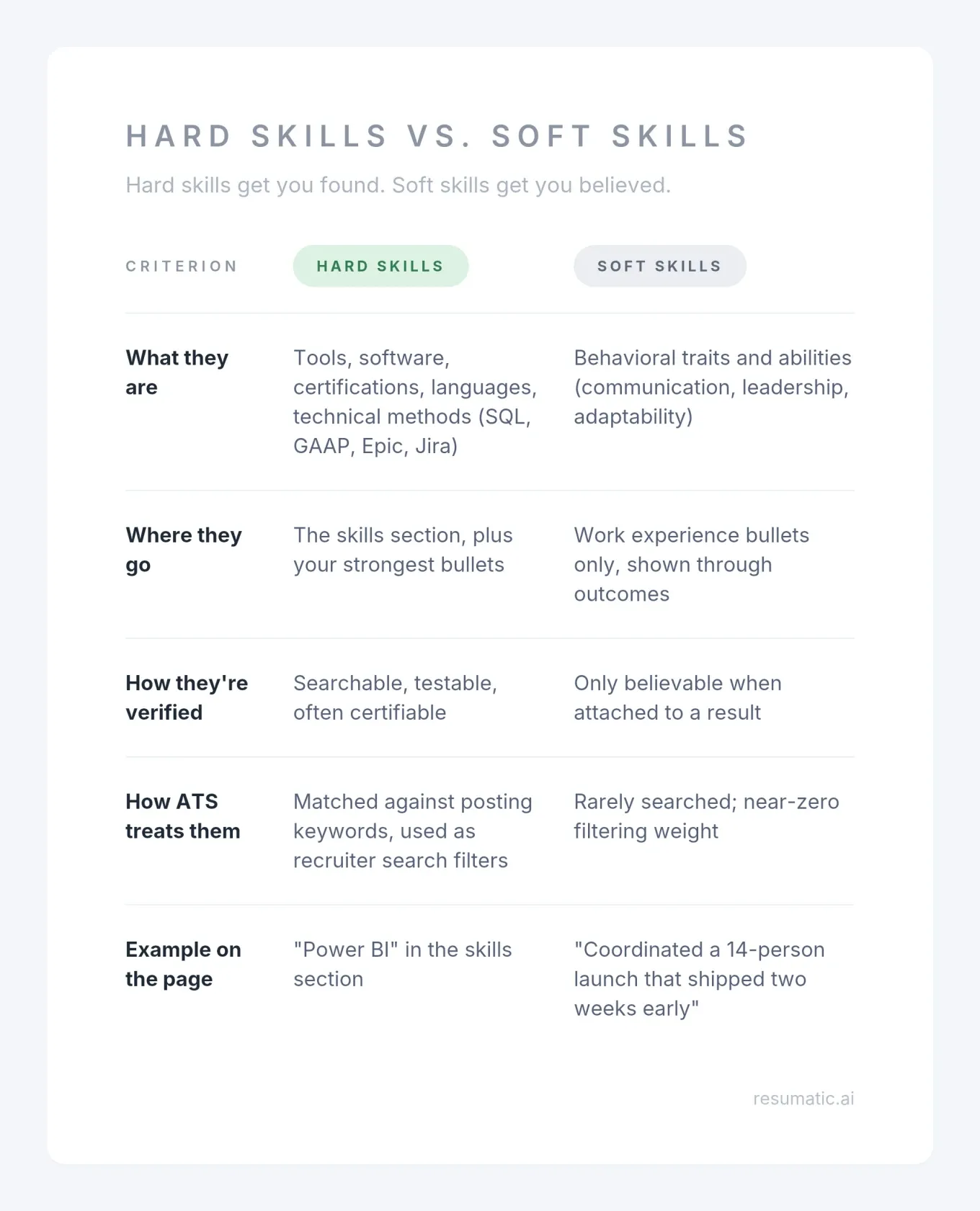
The reason for the split is simple: a recruiter searching their applicant database types "Tableau" or "ICD-10," never "team player." Hard skills are how you get found. Soft skills are how you get believed, and belief comes from the bullet that shows you doing the thing, not from the word sitting in a list.
Which hard skills do employers look for in 2026?
The honest answer is that it depends entirely on the role, which is why generic "top 10 skills" lists don't help much. What follows are the hard skills I see actually moving resumes through screens, organized by job family. Treat each list as a menu to check against your posting, not a list to copy wholesale.
- Marketing: GA4, HubSpot, SEO and SEM, Meta Ads Manager, Google Ads, marketing automation, A/B testing, Looker Studio, CMS platforms (WordPress, Webflow).
- Data and analytics: SQL, Python, Tableau, Power BI, Excel modeling, dbt, statistical analysis, data warehousing (Snowflake, BigQuery).
- Software engineering: the specific languages in the posting (Python, TypeScript, Go, Java), React, AWS or Azure or GCP, Docker, Kubernetes, CI/CD pipelines, Git.
- Finance and accounting: financial modeling, GAAP or IFRS, variance analysis, NetSuite, SAP, QuickBooks, month-end close, advanced Excel (INDEX-MATCH, Power Query).
- Project management: Jira, Asana, MS Project, Agile and Scrum, PMP or CAPM, risk management, budget tracking, stakeholder reporting.
- Sales: Salesforce, HubSpot CRM, Outreach or Salesloft, pipeline forecasting, territory planning, contract negotiation, discovery and demo delivery.
- Operations and supply chain: ERP systems (SAP, Oracle), demand forecasting, Lean and Six Sigma, inventory management, WMS platforms, procurement, logistics coordination.
- Healthcare administration: EHR systems (Epic, Cerner), HIPAA compliance, medical billing and coding (CPT, ICD-10), prior authorization, patient scheduling systems.
- Administrative and customer support: Zendesk or comparable ticketing systems, CRM data management, calendar and travel coordination, invoicing (QuickBooks), Microsoft 365 at the advanced-function level.
Two patterns cut across every family. First, name the tool, not the category: "Tableau" beats "data visualization software" because the recruiter's search query is the tool name. Second, AI skills now show up in postings across all nine families, and the same naming rule applies. "AI" alone is a category; "built prompt-based reporting workflows in Claude" or "Midjourney for campaign concepting" is a skill.
How do you write the skills section on a resume?
Keep it to a clean, scannable block. A single labeled line or a short two-column list works; anything more elaborate works against you. After reviewing resumes for 1,200+ clients and moderating r/resumes for years, the formatting mistakes I see are remarkably consistent, and almost all of them come from resume templates that prioritize looking designed over being readable.
The format that works:
Skills: SQL | Python | Tableau | Power BI | dbt | Snowflake | A/B testing | Stakeholder reporting
That's it. If you have two genuinely distinct skill groups, label them ("Technical:" and "Certifications:"), but resist the urge to build three subcategories with four entries each. Skip skill bars, star ratings, and percentage circles entirely. ATS software can't parse them, recruiters don't trust self-assessed ratings, and a four-out-of-five-stars rating on Excel raises more questions than it answers.
Placement depends on experience level. If you're established in your field, the skills section goes below your work experience, because your last two job titles are stronger evidence than any list. If you're entry level, changing careers, or in a heavily technical field where recruiters filter on stack first, place it above experience so it's in the first scan.
How many skills should you list on a resume?
Eight to twelve. Fewer than eight and the section isn't doing enough matching work against the posting. More than twelve and you've stopped curating, which recruiters notice, because a list of 25 skills tells them you couldn't decide which ones matter for their role. Every skill you add past the relevant ones actively dilutes the strong ones.
The discipline is in the cutting. If you're a data analyst applying to a posting built around SQL, Tableau, and stakeholder reporting, then "HTML" and "Photoshop" don't belong on this version of your resume, even though you have them. The skills section is per-application real estate, not a permanent inventory of everything you've ever touched.
How do you match your skills to the job description?
Mirror the posting's exact phrasing. If the posting says "Search Engine Optimization," write "Search Engine Optimization (SEO)," not just "SEO," because you don't know which string the recruiter will search. The same goes for certifications ("Project Management Professional (PMP)") and software with common name variants.
A persistent myth worth killing here: ATS software does not auto-reject resumes that are missing keywords. What actually happens is more mundane and arguably worse. The recruiter searches or filters the applicant pool by the two or three skills they care about most, and resumes that didn't use those exact terms never appear in the results. You weren't rejected; you were never seen. Mirroring the posting's language is how you stay in the result set.
Tailoring the skills section takes about five minutes per application: read the posting, highlight the named tools and methods, reorder your list so the matching ones come first, and cut the ones that don't apply to this role.
Which skills actually hurt your resume?
This is the part most skills guides skip, and it's where I see the most damage in practice. A meaningful share of the resumes that come through my practice and through r/resumes don't have a missing-skills problem. They have a wrong-skills problem, and the wrong entries do real harm because they reframe how the recruiter reads everything else on the page.
The entries that consistently hurt:
- Soft-skill padding. "Team player," "hard-working," "detail-oriented," and "strong communication skills" are claims, not skills. Listing them signals you didn't have enough real skills to fill the section.
- Baseline computer literacy. "Microsoft Word," "email," and "internet research" on a professional resume tell the recruiter your bar is low. The exception is administrative roles where a posting explicitly asks, and even then, specify the advanced capability.
- Skill bars and self-ratings. Covered above, but worth repeating because template builders keep generating them: they're unparseable, unverifiable, and they invite skepticism.
- Vague AI entries. "AI" or "ChatGPT" with no context reads as trend-chasing. Name the workflow you built or the output you ship with it.
- Obsolete tech, unprompted. Flash, Lotus Notes, or a 2009-era framework date you unless the posting specifically asks for legacy-system experience.
- Skills you can't survive an interview on. Keyword-stuffing the section with tools you've barely opened works right up until the first technical question. The skills section is a promise the interview will collect on.
- The competency cloud. A block of 15 to 20 abstract nouns ("Strategic Visioning | Change Leadership | Operational Excellence") at the top of an executive resume. It's the senior-level version of soft-skill padding, and recruiters scroll straight past it.
If your current resume has two or more of these, fixing the skills section is probably the highest-leverage 20 minutes you can spend on it.